There's a specific kind of dread that hits somewhere between the airport and your holiday destination. You've settled into your seat. The flight's about to take off. And then the thought arrives: Did I switch off the pump? Most Indian homeowners have lived some version of this. The vacation starts well, but the anxiety doesn't.
There’s a specific kind of dread that hits somewhere between the airport and your holiday destination.
You’ve settled into your seat. The flight’s about to take off. And then the thought arrives: Did I switch off the pump?
Most Indian homeowners have lived some version of this. The vacation starts well, but the anxiety doesn’t. And it almost always comes from the same two places: water and power. The pump that might run dry. The overhead tank that might overflow. The refrigerator sitting unprotected through an overnight voltage spike while no one is home to notice.
The good news is that most of these worries are completely solvable before you leave, not by calling a neighbour every few hours, but by having the right Smart Water and Power Management Solutions in place. Systems that handle your home while you’re away, without needing you to be there.
Water Safety, Before You Lock the Door
- Switch Your Pump to Automatic Mode
If your home has a Water Level Controller, confirm it’s set to Auto before you leave. This ensures the pump runs only when the overhead tank needs filling and stops the moment it’s full. No overflow. No unnecessary pump cycles. No one needs to touch anything while you’re gone.
If you’re still switching the pump manually, a vacation is one of the strongest reasons to upgrade to an Automatic Pump Control System before your next trip.
- Confirm Dry Run Protection Is Active
Before leaving, do a quick check, run the pump briefly, and confirm the controller responds correctly to sensor inputs. A motor running without water for even a few minutes can suffer irreversible winding damage. Built-in Dry Run Protection cuts the pump the moment the sump empties, protecting your motor until water returns, completely automatically, with no one home.
- Close All Taps and the Main Stop Cock
Walk through every bathroom, the kitchen, and the utility area. Confirm every tap is fully closed. If your home has an inline stop cock for the main supply, turn it off completely. This isolates your internal plumbing from the external supply, eliminating any risk from a dripping tap or a partially open valve over ten days.
- Check for Existing Pipe Leaks
A pipe joint seeping slowly for weeks becomes a real problem over a long absence. Press a dry cloth against each joint under sinks, behind the washing machine, and near the water heater connections. Any moisture shows up immediately. Fix what you find before you leave; what’s a minor inconvenience today is a flooded utility room by the time you’re back.
- Switch Off and Drain the Geyser
Switch the geyser off at the main wall switch, not just the thermostat. For a trip longer than a few days, drain it if possible. A drained, switched-off geyser creates zero risk. One left on for ten days creates several.
Power Safety, What Needs Attention Before You Go
- Unplug Everything Non-Essential
The most straightforward Power Protection step is to unplug what doesn’t need to be running. Televisions, computers, set-top boxes, gaming consoles, decorative lighting, all can be unplugged completely. An appliance that’s physically disconnected cannot be damaged by a surge, a spike, or a voltage event. For non-essential electronics, this is the most complete protection available.
- Protect the Appliances That Must Stay On
The refrigerator, router, and security cameras need to remain powered. These appliances need Power Protection more than ever when you’re not home, because there’s no one to notice if something goes wrong.
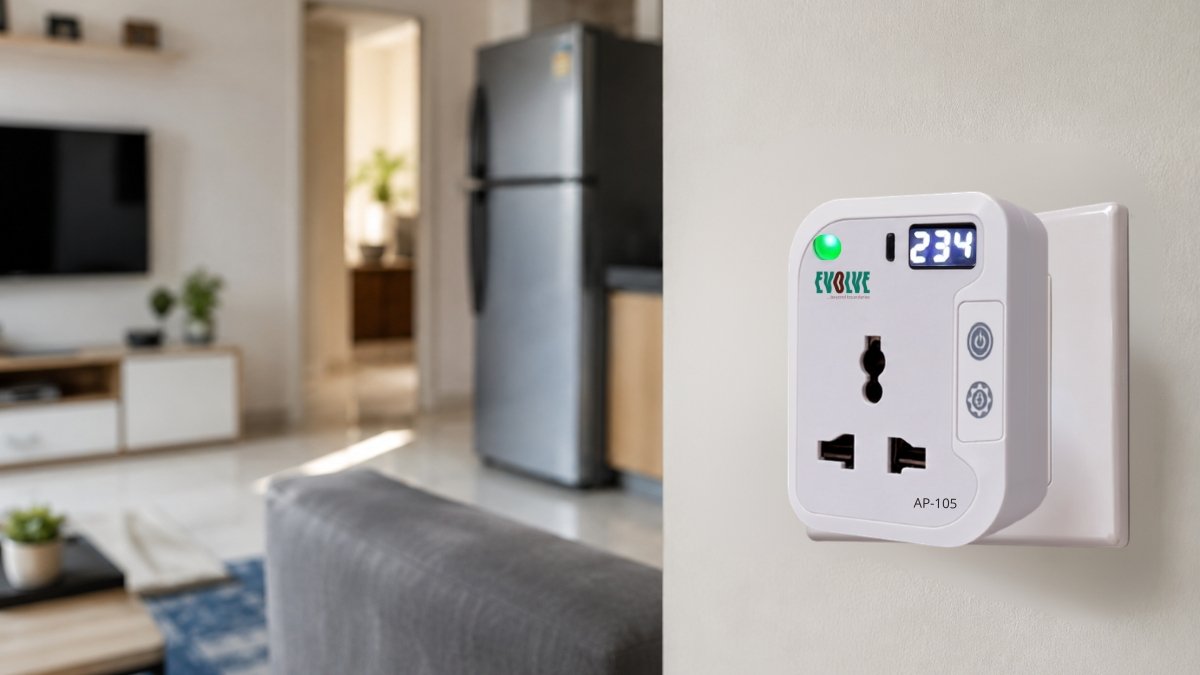
A quality Surge Protection device inline between the wall socket and each of these appliances intercepts voltage spikes before they reach internal circuits. A device with high and low voltage protection goes further, disconnecting the appliance if supply voltage drifts outside safe limits and reconnecting automatically when it stabilises. For the refrigerator specifically, look for a protector with a restart delay, it holds the compressor offline for a few minutes after power restoration, protecting it from starting under unstable post-outage conditions.
- Check Panel-Level Surge Protection
If your home has a whole-house Surge Protection device at the distribution board, check that its status indicator is showing correctly before you leave. Panel-level surge devices have a finite absorption capacity, after a significant event, some types need replacement. If you don’t remember the last time it was checked, now is the right time.
- Switch Off All Heavy Appliances at the Wall
Air conditioners, geysers, microwaves, electric kettles, all off at the wall switch, not just the remote or button. Appliances in standby draw power and remain exposed to Power Protection failures. This one step eliminates risk for everything that doesn’t need to run.
- Protect Your EV Charger Point
If your EV charging point remains active while you’re away, it’s exposed to the full range of Power Protection risks, surges from storm-related grid events, overvoltage on power restoration, and earth leakage from wet conditions. A dedicated EV protector handles all of these automatically, with no intervention required. It’s one of the most overlooked Smart Water and Power Management Solutions for homes with EV charging infrastructure.
The At-a-Glance Checklist
Water
- Pump set to Auto mode, Automatic Pump Control System active
- Dry Run Protection confirmed working
- All taps closed, main stop cock off
- Pipe joints checked for leaks
- Geyser switched off at wall, drained
Power
- All non-essential appliances unplugged
- Fridge, router, cameras protected with Surge Protection device
- Fridge protector has restart delay active
- Panel Surge Protection status confirmed
- AC, geyser, heavy appliances off at wall
- EV charger point protected with dedicated Power Protection
Leave with Nothing Unresolved
A ten-day absence in India’s power and water environment is a long time for things to go wrong unnoticed. Monsoon storms bring voltage surges every night. Summer drops borewell levels. Post-outage grid restoration sends spikes through every connected appliance.
None of these are unusual. All of them are preventable, with the right Water Management Protection and Power Protection in place, and a thorough check before you step out.
Do this once properly, and it becomes a ten-minute habit before every trip. One that lets you actually enjoy your vacation, without the mid-flight dread.