Every household with an overhead tank has a version of this story: someone forgets to switch off the motor, the tank overflows, water runs down the terrace for an hour, and the electricity bill quietly climbs while nobody notices. I've lived through this exact scenario more times than I'd like to admit. Water pumps are
Every household with an overhead tank has a version of this story: someone forgets to switch off the motor, the tank overflows, water runs down the terrace for an hour, and the electricity bill quietly climbs while nobody notices. I’ve lived through this exact scenario more times than I’d like to admit. Water pumps are one of those things we only think about when they stop working, or when they flood the terrace at 2 AM.
Here are five problems that show up in almost every Indian home with a water pump, and the automation fix that actually solves each one instead of just patching it temporarily.
- The tank overflows because someone forgot to switch off the motor
This is one of the most common complaints. Someone starts the pump, gets distracted by a phone call or the doorbell, and twenty minutes later, there’s water spilling over the terrace wall. It’s wasteful, it’s annoying, and over a month, it adds up to a real amount of wasted water and electricity.
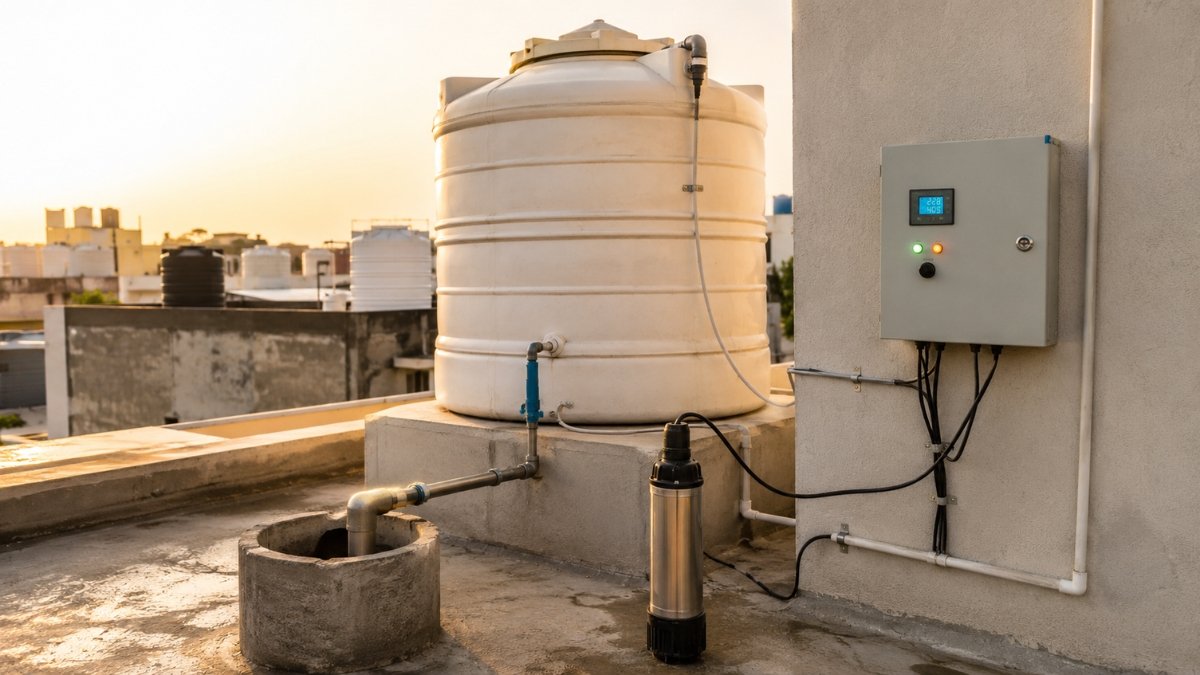
The fix: An automatic water level controller solves this completely. It senses when the tank is full and cuts power to the motor on its own, no manual monitoring required. Once it’s installed, overflowing stops being a thing you have to think about.
- The motor runs dry and burns out
If the borewell or sump runs low and the pump keeps running anyway, it overheats fast. A dry-running motor is one of the quickest ways to shorten a pump’s life, sometimes killing it in a single afternoon. I’ve seen this happen during summer months when groundwater levels drop and nobody thinks to check before switching the motor on.
The fix: Dry run protection is a small addition that makes a huge difference. It automatically detects when there’s no water flow and shuts the motor off before any damage happens. For borewell-based systems, especially, this single feature can add years to a motor’s life.
- Voltage fluctuations damage the pump motor
Motors are sensitive to unstable current, and the Indian power supply isn’t always kind to them. Voltage swings, especially the ones that happen during monsoons or peak load hours, put a lot of stress on the motor windings. Over time, this leads to overheating, reduced efficiency, or outright motor failure.
The fix: Pairing your pump with proper voltage protection, like a stabilizer or an automatic voltage controller built into the pump starter, keeps the motor running within a safe range regardless of what the grid is doing. It’s one of those upgrades that’s invisible until the day it saves your motor.
- Manually switching the pump on and off every single day gets exhausting
Even without any of the above issues, there’s the plain fatigue of managing a pump manually, checking the tank, remembering timings, and running up to the terrace to check water levels. In households where everyone’s out at work, this becomes a genuine daily hassle, and it’s usually the reason problems like overflowing happen in the first place.
The fix: Full pump automation, combining level sensors, motor protection, and a smart starter, removes the daily manual work entirely. The system handles switching on, switching off, and monitoring, so nobody has to remember anything.
- Sudden power fluctuations or single-phasing can damage the motor without warning
This one’s less talked about but fairly common with three-phase motors used in borewell pumps. If one phase drops out (single-phasing) or there’s a sudden power surge, the motor can burn out within seconds, often without any obvious warning sign beforehand.
The fix: A pump starter panel with built-in surge protection and phase-failure detection catches these issues instantly and cuts power before the motor takes damage. It’s a small component that ends up protecting a fairly expensive piece of equipment.
Conclusion
Most of these problems aren’t really about the pump itself; they’re about the lack of any system watching over it. A basic automatic water level controller, some dry run protection, and decent voltage protection together turn a pump that constantly needs babysitting into one that quietly does its job. Worth the investment, honestly, especially if you’ve already dealt with even one overflowing terrace or a burnt-out motor.