You switch on the AC. It hesitates, then starts. The lights flicker for a second. Your refrigerator makes a slightly different sound than usual.Most of us notice these things and move on. What we don’t realise is that these small signs often point to an unsafe voltage supply at home, and that’s exactly what slowly
You switch on the AC. It hesitates, then starts. The lights flicker for a second. Your refrigerator makes a slightly different sound than usual.
Most of us notice these things and move on.
What we don’t realise is that these small signs often point to an unsafe voltage supply at home, and that’s exactly what slowly damages expensive appliances like TVs, washing machines, air conditioners, and smart electronics.
With homes now packed with sensitive electronics, home voltage safety isn’t a technical concern anymore. It’s a daily, practical one.
Let’s break this down simply.
Why home voltage safety matters more than ever
A decade ago, most homes ran on basic electrical devices. Today, even a “normal” home has inverter ACs, smart TVs, Wi-Fi routers, dishwashers, and chargers running all day.
These appliances are designed to work within a narrow voltage range. When voltage goes up or down too often, internal components take stress, even if the appliance doesn’t fail immediately.
In many Indian cities and towns, voltage fluctuations are still common due to:
- Overloaded local transformers
- Seasonal demand spikes (especially in the summer)
- Ageing wiring inside buildings
- Sudden power restoration after outages
The result? Appliances age faster than they should.
The real risks of ignoring voltage problems
Voltage issues don’t always cause dramatic failures. Most damage is slow and invisible.
Here’s what typically happens when voltage isn’t stable:
- AC compressors weaken over time
- TV panels develop faults after repeated surges
- Refrigerator control boards fail unexpectedly
- Chargers and adapters overheat or stop working
By the time something breaks, the warranty is often over, and repair costs are not small.
This is exactly why relying only on “luck” or assuming the wiring is fine is risky.
How to check if your home voltage is safe (without calling an electrician)
You don’t need professional tools to get a basic idea. A few practical checks can tell you a lot.
1. Observe appliance behaviour
If the lights dim when the AC starts, or the refrigerator clicks on and off frequently, voltage variation is likely.
2. Notice seasonal patterns
If appliance issues increase during summer afternoons or late nights, it’s often due to grid load fluctuations.
3. Check charging behaviour
Mobile chargers heating up more than usual or charging inconsistently is another early sign.
4. Use a smart plug
A smart plug with voltage monitoring can show real-time voltage levels on your phone. This is one of the simplest ways to understand what your home is actually receiving, not what it’s supposed to receive.
Many people are surprised to see how often voltage goes beyond safe limits.
Understanding voltage protection solutions (in simple terms)
Once you know voltage isn’t always stable, the next step is protection. This is where people often get confused.
Surge protection vs voltage protection
A power surge protector or Surge Protector Plug mainly handles sudden spikes, like those caused by lightning or abrupt power restoration.
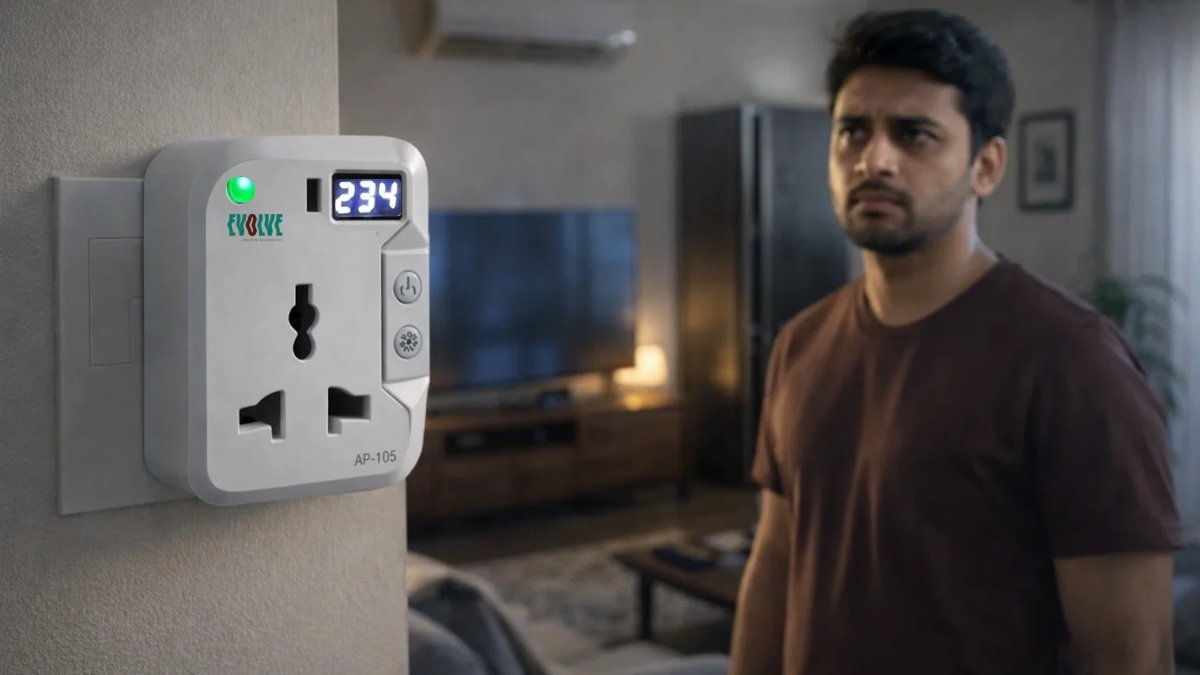
A Voltage protector or home voltage protector goes a step further. It monitors incoming voltage continuously and cuts off power if it goes too high or too low, reconnecting only when things are safe again.
For sensitive appliances, that difference matters.
Appliance-level protection works better
Instead of protecting the whole house at once, using a Power Protection Plug for individual high-value appliances offers more control and reliability.
It’s targeted. And often more cost-effective.
How Evolve approaches appliance voltage protection
Evolve designs protection devices keeping Indian power conditions in mind, not ideal lab conditions.
Their power surge protector and Voltage protector solutions are built to:
- Detect unsafe voltage instantly
- Cut off power before damage occurs
- Automatically restore supply when the voltage stabilises
Paired with a smart plug, users can also monitor voltage behaviour instead of guessing.
The idea is simple: don’t wait for damage. Prevent it quietly, in the background.
Practical benefits you actually notice
Using a proper home voltage protector doesn’t change how your appliances work day to day. That’s the point.
What you do notice over time:
- Fewer sudden appliance failures
- Lower repair and replacement costs
- Better performance consistency
- Peace of mind during power cuts and restorations
It’s protection you stop thinking about, because it’s doing its job.
Safety, reliability, and long-term trust
Electrical protection devices should never be complicated or fragile. They sit between your appliance and an unpredictable power supply, so reliability matters more than features.
Evolve products are designed with:
- Certified safety components
- Clear-cut off thresholds
- Durable build for Indian conditions
No complex setup. No constant monitoring needed.
Just plug in and let it work.
A simple next step
If your home has appliances you’d rather not replace anytime soon, start small.
Check voltage behaviour using a smart plug.
Protect your most expensive appliance first with a Power Protection Plug or Voltage protector.
You don’t need to overhaul your entire electrical system.
Just make smarter, quieter choices that keep your appliances safe, without drama.
That’s usually enough.