A farmer in Tamil Nadu once explained irrigation in the simplest possible way. “Some days the field asks for water. Some days it doesn’t. The hard part is figuring out which day is which.” That sentence sticks because it captures the reality of farming better than most technical explanations ever could. For years, irrigation decisions
A farmer in Tamil Nadu once explained irrigation in the simplest possible way.
“Some days the field asks for water. Some days it doesn’t. The hard part is figuring out which day is which.”
That sentence sticks because it captures the reality of farming better than most technical explanations ever could.
For years, irrigation decisions were built on experience, observation, and routine. Farmers walked their land, checked the soil by hand, watched the sky, and trusted patterns they had learned over decades. But farming today feels different. Rainfall shifts unexpectedly. Summers last longer. Electricity costs climb. Labor is harder to find.
The old methods still matter, but they are no longer enough on their own.
That’s one of the biggest reasons smart wireless irrigation systems are becoming part of modern agriculture. Not because farmers suddenly want more technology, but because managing water has become too important to leave to guesswork.
Farming Has Become More Unpredictable
Most people outside agriculture assume irrigation is simple. Turn the water on. Turn it off.
In reality, even small irrigation mistakes can affect an entire season.
Too much water can weaken roots, waste electricity, and create conditions where disease spreads faster. Too little water stresses crops during critical growth stages. Sometimes the damage is visible immediately. Sometimes it only shows up later during harvest.
What makes things harder now is unpredictability.
A field that needed irrigation every three days a few years ago may behave completely differently today because of changing temperatures and inconsistent rainfall. Farmers are constantly adjusting.
On larger farms, this becomes exhausting. One area may still hold enough moisture after light rain, while another section dries out quickly under direct sunlight. Managing that manually takes time and constant monitoring.
That’s where smart wireless irrigation systems start making practical sense.
The Problem With Fixed Irrigation Schedules
Many traditional irrigation systems still run on fixed timings.
For example, watering starts every morning at 6 AM for a set number of hours, whether the soil actually needs it or not.
That approach worked reasonably well when weather conditions were more stable. Today, it often leads to wasted water and unnecessary pump usage.
There’s also the issue of human limitation.
Even experienced farmers cannot physically monitor every corner of a large property all day long. A leaking pipeline, uneven watering, or pump issue may go unnoticed for hours.
And usually, irrigation problems don’t happen at convenient times.
They happen late at night. During unexpected rain. Or when someone is already dealing with ten other farm tasks.
Most farmers are not looking for complicated technology. They simply want better visibility and more control without adding more daily stress.
What Makes Smart Irrigation Different
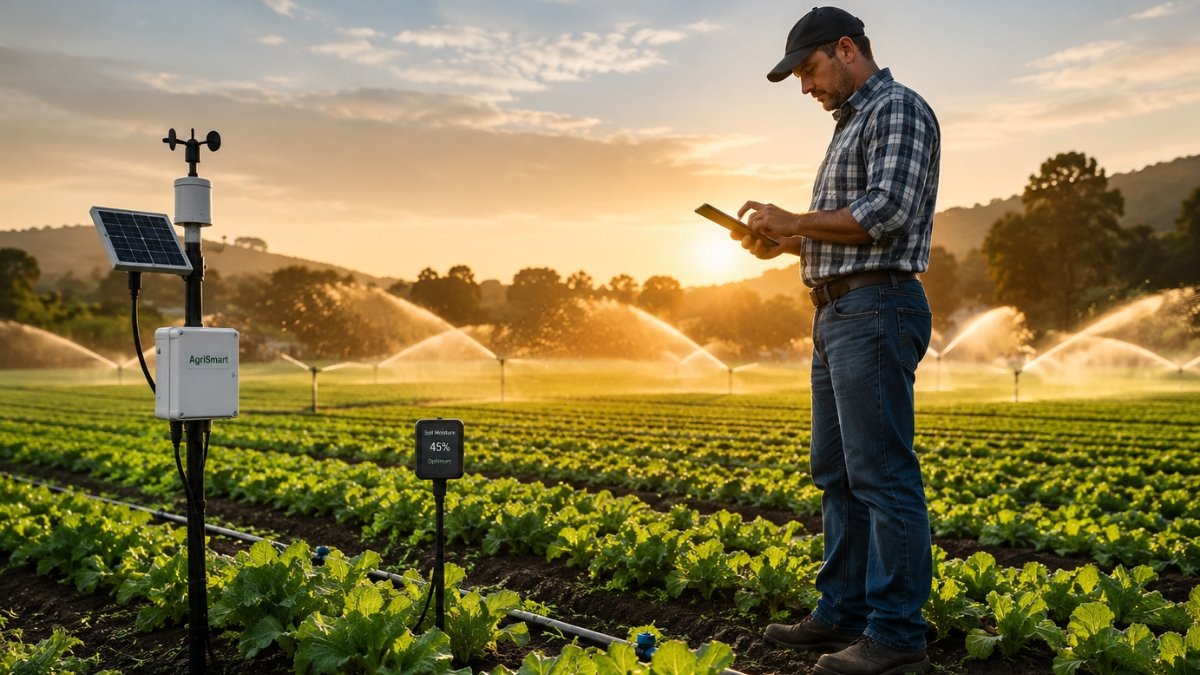
A smart wireless irrigation system works by collecting real-time information from the field and using that data to improve irrigation decisions.
The system may monitor:
- Soil moisture
- Temperature
- Humidity
- Weather conditions
- Water flow levels
Instead of relying only on preset schedules, irrigation can respond to actual field conditions.
If moisture levels are already sufficient after rainfall, watering can be delayed automatically. If one section of land dries faster than another, irrigation can be adjusted zone by zone.
That level of precision matters more than people realize.
Farmers are no longer watering blindly. They’re responding to what the field actually needs.
Wireless connectivity also changes how farms are managed day to day.
A farmer doesn’t necessarily need to travel across the property every time they want to check irrigation status. Monitoring can happen remotely through a mobile device or dashboard.
For many operations, that alone saves hours every week.
Why Farmers Are Slowly Moving Toward Smarter Systems
Most agricultural technology trends come with a lot of hype. Farmers hear big promises every season.
That’s why adoption usually happens slowly.
People want proof.
The reason smart wireless irrigation systems are gaining attention is because the benefits are visible in everyday operations, not just marketing presentations.
Water usage becomes easier to track.
Electricity waste is reduced because pumps are not running longer than necessary.
Irrigation schedules become more flexible during changing weather.
And perhaps most importantly, farmers spend less time worrying about whether the field is getting the right amount of water.
That mental load matters more than most discussions about technology acknowledge.
Agriculture already demands constant decision-making. Anything that reduces uncertainty without making operations more complicated becomes valuable very quickly.
How Evolve Solutions Fit Into Modern Agriculture
At Evolve, the focus is not on adding technology for the sake of appearance.
The goal is to support practical farm operations with systems that are reliable, manageable, and useful in real conditions.
Agricultural environments are demanding. Equipment must continue functioning through heat, dust, rain, and long working hours. Farmers don’t need systems that look impressive during demonstrations but become difficult to manage later.
Evolve solutions are designed to help improve irrigation visibility and control while keeping the experience straightforward.
That means farmers can monitor conditions more efficiently, respond faster to irrigation needs, and manage water usage with greater confidence.
For larger farms managing multiple irrigation zones, this becomes especially important.
The idea is not to replace farming knowledge. Experienced farmers already understand their land deeply. Technology simply helps support better timing and faster decisions.
The Real Benefit Is Better Control
When people talk about agricultural technology, they often focus heavily on features.
But most farmers care more about outcomes.
Can the system help reduce water waste?
Can it save time?
Can it make irrigation easier to manage during unpredictable weather?
Can it help avoid costly mistakes?
That’s where smart wireless irrigation systems are creating real value.
They help farmers move away from reactive irrigation toward more informed decision-making.
And interestingly, many farmers who adopt these systems say the biggest improvement isn’t just efficiency.
It’s peace of mind.
Knowing that irrigation conditions can be monitored remotely changes the daily pressure of farm management. Problems can often be identified earlier. Adjustments can happen faster.
That kind of operational confidence becomes extremely important during critical growing periods.
Farming Is Becoming Smarter, Not Less Human
There’s sometimes a misconception that technology removes the human side of farming.
In reality, the opposite is happening.
Modern systems still depend heavily on farmer experience and judgment. Technology simply provides better information to work with.
A smart irrigation system cannot replace years of understanding soil behavior, crop timing, and seasonal patterns. But it can help farmers respond more accurately when conditions change.
And conditions are changing constantly.
As agriculture faces increasing pressure around water conservation and operational efficiency, smarter irrigation management will likely become a normal part of farming rather than a specialized upgrade.
The farms that adapt successfully will not necessarily be the ones with the most technology.
They’ll be the ones using technology in practical, reliable ways that genuinely support everyday operations.
For farmers exploring more efficient irrigation management, Evolve provides solutions designed to support modern agriculture with dependable, easy-to-manage systems built around real farming needs.